


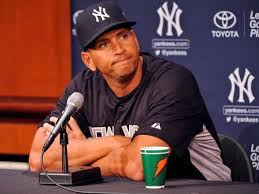
 New York Yankees slugger Alex Rodriguez (hereinafter “A-Rod”) was recently suspended for 211 games by Major League Baseball for his involvement with performance-enhancing drugs. However, as of this writing, A-Rod is currently playing third base for the Yankees. Why is this? The reason is that the collective bargaining agreement between the Major League Baseball Players Association (MLBPA) and Major League Baseball (MLB) allows any player suspended for this reason to appeal his penalty to a neutral, third-party arbitrator, and to continue to play until the arbitration appeal is resolved.
The existence of a neutral arbitrator in these situations is quite common in most labor – management agreements. In fact, the first executive director of the MLBPA, Marvin Miller, had a background working for the United Steelworker’s Union prior to taking the MLBPA position. Because of his prior experience negotiating with U.S. Steel, he recognized the importance of a neutral, third party arbitrator to resolve disputes. In the 1968 Basic Agreement between MLB and the MLBPA, the parties agreed to the appointment of such an arbitrator.
In 1976, Peter Seitz, as arbitrator, resolved a dispute involving whether a player could “play out his option” and become a free agent after his existing contract expired and was renewed for one year by his team. Seitz ruled that the team’s renewal option was for one year only, and, after that renewal or “option” year, a player would become a free agent, free to negotiate with any team. The team owners were quite chagrined at this outcome, and immediately fired Seitz, but the ruling stood, giving players the leverage to negotiate a new labor agreement allowing them to become free agents after a certain period of major league service time.

 Many of us have seen the slick advertisements on television for reverse mortgages. An actor who is popular with our seniors will advocate the advertiser’s reverse mortgage program as a way to tap home equity and enjoy the “good life”, the long awaited vacation or purchase of a new car or boat. However, the reality of reverse mortgages can be quite contrary to these advertisements.
 New York City’s population density inherently gives rise to noise complaints by cooperative neighbors.
  The resurging real estate market brings with it the real estate “flipper”. A flipper is a person or entity that purchases property with the goal of renovating it for a quick sale at a substantial profit. The flipper never intends to occupy the property in the neighborhood. Recently,
  Our readers may be aware of an
  A
A 
 Real estate transactions commonly involve the inclusion of title insurance policies. For the purposes of this blog post, we will be discussing title insurance obtained when a person purchases a house. Title insurance is a unique type of insurance, in that the events that are to be covered have already occurred. For instance, an automobile policy covers loss resulting from an accident that could happen after the policy is bound. On the other hand, title insurance covers acts that have already happened but not discovered prior to closing, such as a fraudulent deed in the chain of title.
 Our firm often fields inquiries from clients regarding residential lease situations. One common question relates to the right to renew an existing lease. This blog post will explain certain conditions which may apply to the renewal of a lease after it expires.