 New York Real Estate Lawyers Blog


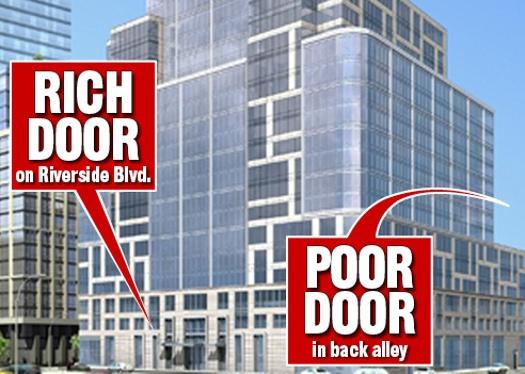 A recent news story regarding affordable housing in New York may be of interest to readers of our blog. New York City’s Department of Housing Preservation and Development (HPD) approved a separate entrance in a proposed new building containing affordable housing units. The building would therefore have two entrances (it is located on a corner lot), one for the luxury units, and one for low-income units that would comprise 55 of the 219 proposed units.
Of course, many people are outraged by this “poor door,” arguing that it imposes a stigma on the low-income renters in the building. Others may argue that separate entrances should be allowed as the price for the builder to include these low-income units, which may not have otherwise been part of the proposed project. Including these low-income units in the project allows the builder to construct an edifice larger than that which would have been allowed if the building only contained luxury units. It also entitles the developer to certain tax breaks for providing “affordable housing” to the residents of New York City.
The issue of whether all residents of communal housing, such as an apartment building, are entitled to share in all of the building’s amenities can create additional legal challenges. A building in the Chelsea neighborhood of Manhattan has an indoor swimming pool, a rare sight in Manhattan. There are several buildings with access to the pool, known as London Terrance Towers and London Terrace Gardens. However, these buildings contain co-op apartments, which are owner-occupied, as well as rent-stabilized units, which are not. Under an expiring agreement, between the landlord of the Gardens buildings and the cooperative corporation, the renters were allowed to use the pool.
 A recent article in the
  Memorial Day weekend is eagerly anticipated by many of our readers, especially this year after the harsh winter that we endured. Fortunate travelers expect to enjoy their vacation homes this weekend. As you head out for the weekend,
 Our readers may have read a
  A
A  Some of our
  An article in
  New York City’s population density inherently gives rise to noise complaints by cooperative neighbors.
  Our firm often fields inquiries from clients regarding residential lease situations. One common question relates to the right to renew an existing lease. This blog post will explain certain conditions which may apply to the renewal of a lease after it expires.