Articles Posted in Foreclosure

foreclosure-and-bankruptcy.jpgA recent decision by the United States Supreme Court raises important issues for those whose homes are in foreclosure and are considering filing for federal bankruptcy protection. This case involved a borrower whose home was “underwater,” which means that the mortgage debt on the property (both a first and second mortgage) exceeded the current value of the home. In such cases, the bankruptcy counsel will often seek to have the second mortgage “stripped off,” that is, removed, so that it is no longer a lien on the property.

The Supreme Court ruled that, in such situations, the second mortgage could not be removed simply because the house was worth less that the total mortgage debt. This ruling will prevent such homeowners from having second mortgage loans (which are often in the form of home equity loans) discharged by the Bankruptcy Court in a Chapter 7 liquidation proceeding. This ruling protects banks that make second mortgages from having these mortgages dismissed in bankruptcy proceedings where the home currently has a negative equity.

Our firm handles many cases in which we defend homeowners who are in foreclosure. We are often asked what the effect of a bankruptcy filing would be on such a proceeding. The first effect of a bankruptcy filing is to freeze all current litigation against the person filing for bankruptcy, as well as all collection efforts on any debts. Therefore, if an individual is delinquent in their mortgage payments, a bankruptcy filing would suspend all collection letters, phone calls, and, of course, litigation relating to all debts, including mortgage debts. Failure to comply with the automatic bankruptcy stay may subject the lending institution to Court sanctions, including fines.


courthouse.jpgOur firm handles many cases in which the client is being sued for foreclosure of their property. In general, a foreclosure lawsuit involves a mortgage loan which has been recorded as a lien against real property, such as a house or condominium unit. Please note that cooperative apartments involve ownership of shares in the cooperative corporation, and therefore are not subject to the judicial foreclosure process.

Due to the large volume of foreclosures in New York in recent times, and the desire to protect homeowners, a law was passed in New York State several years ago requiring mandatory settlement conferences in residential foreclosure actions. This requirement does not apply to commercial foreclosures, nor to situations where the owner of the property being foreclosed does not reside at the property.

The purpose of this law is to attempt to resolve foreclosure cases before extensive litigation occurs. The law requires that, after the party foreclosing (the lender) files proof with the Court that the borrower was served with the foreclosure lawsuit, the Court must hold a mandatory settlement conference within sixty (60) days of such filing. In general, the Court will issue a written notice to all parties advising them of the date, time, and location of the settlement conference. It is important to advise your attorney if you receive such a written notice, so that they will be able to attend the conference on your behalf.

hauntedhouse.jpgEven Halloween gives rise to legal issues that may pertain to our blog readers. This blog post will address haunted houses, zombie houses, ghosts and other scary situations from a legal perspective.

Unfortunately, a crime, suicide or other unpleasant event may have happened in a house prior to sale. Such a house may be considered to be “haunted”. Does New York law require disclosure that the house is haunted to a potential buyer? The answer is no. New York is a caveat emptor state, meaning “let the buyer beware”. Psychological issues do not require disclosure. It is the buyer’s responsibility to conduct inspections, ask questions and develop her own opinion about the neighborhood, school district and conditions in the house. Once the buyer has accepted delivery of the Deed at the closing, she has no claim against the seller for property conditions except those that specifically survive the closing according to the contract between the parties.

The only exception to this concept is New York’s Property Disclosure Law . This requires the seller to complete an extensive list of questions detailing property condition, such as has there ever been an oil tank at the property, is the electrical system original and the like. If a seller does not provide the completed Property Disclosure form, a $500.00 credit is to be provided to the buyer at closing. Interestingly enough, in upstate New York, most sellers complete the Property Disclosure form, while in downstate counties typically served by our firm, most sellers opt to credit the buyer at closing rather than complete said form.

cuevas.jpg Recently in the news is the rather gruesome story of a woman who was murdered and dismembered. Her body parts were discovered in Nassau and Suffolk Counties. Her neighbor was arrested for her murder and is being held without bail. According to the news story, the root of the conflict between the two women appears to have been a landlord-tenant dispute.

The accused murderer, Leah Cuevas, was pretending to be the landlord of the building in which the two women lived, after the actual owner passed away. Ms. Cuevas then attempted to collect the rent from the building’s tenants, and when fellow tenant Chinelle LaToya Thompson Browne refused to pay, she was allegedly murdered by Ms. Cuevas. Of course, most landlord-tenant conflicts do not end in this manner. This blog post will attempt to discuss the legal issues involved, although, as our firm does not generally practice criminal law, we will leave the more graphic issues to the criminal courts.

Often, a situation can arise where a person claims to be the owner and/or landlord of a house or apartment building and demands rent from the tenants. This can happen where the original landlord passes away without a will, or where the building is being foreclosed by a lender. There may be occurrences where a landlord cannot meet the carrying charges on a building, such as the mortgage and utilities, and simply “walks away” from their ownership. If the ownership is in a corporate name, the landlord may not be personally liable for the building’s debts, and does not dispute any foreclosure proceeding that may occur.

beachhouse.jpgMemorial Day weekend is eagerly anticipated by many of our readers, especially this year after the harsh winter that we endured. Fortunate travelers expect to enjoy their vacation homes this weekend. As you head out for the weekend, we wish to remind you of certain legal issues pertaining to vacation homes.

Some vacation homes were financed by the use of reverse mortgages . Once the borrower dies or does not occupy the home for another reason, the lender may seek to collect the remaining unpaid principal balance, require the home to be sold or foreclose on the property. Since vacation homes are secondary homes, obtaining a mortgage modification, if necessary due to the financial circumstances of the borrower, is not a certainty. We are available to assist our clients in foreclosure defense should it become necessary.

Sometimes a vacation home is inherited by more than one adult child. In this case, maybe not all of the record owners contribute to the expenses of the house or even use the house. Our firm has been engaged in partition actions on behalf of its clients to alleviate this situation.

self.jpg Our firm often receives inquiries from potential clients, many related to foreclosure and landlord-tenant matters. Often, an individual will inform us that they have been representing themselves in a Court proceeding, or are considering doing so, and will question us as to whether an attorney is necessary.

In New York State, individuals are generally permitted to represent themselves in Court proceedings, without an attorney. One exception to this is a corporation. Even if an individual is the sole owner of a corporation, corporations must generally be represented by counsel when they are a party to a litigation proceeding.

However, simply because an individual may representative herself in Court, does not mean that this is the best decision when confronted with an adversarial proceeding concerning potentially sophisticated legal issues, such as a foreclosure proceeding, or landlord-tenant matter. Many of the people who make inquiries to our firm will ask what benefit is gained from hiring an attorney, especially since there is an increased cost involved when attorney’s fees are incurred.

reverse.jpg A recent article in the New York Times discusses the pitfalls of reverse mortgages, including the effect such a mortgage may have on the heirs of the borrowers in question. A recent blog post also examined the possible negative legal ramifications of reverse mortgages on seniors and their surviving spouses. This article will discuss possible legal defenses when a reverse mortgage is being foreclosed, or threatened to be foreclosed, by a lending institution.

The first person to be impacted by a reverse mortgage default is usually the surviving spouse of the borrower. This situation can occur when only one spouse is obligated under the reverse note and mortgage. There are several reasons why this can happen. It is possible that one spouse has poor credit, and cannot qualify for a loan. In addition, in order to qualify for a reverse mortgage, the borrower must be at least 62 years old. A couple may own a property jointly, where one spouse is over 62, and the other is younger. In that case, the reverse mortgage may be made to only the older of the owners. In this example, the lender will often force the non-borrowing spouse to remove their name from the title of the property being borrowed against as a condition to making the loan. This may cause additional legal problems if the non-titled spouse survives the borrowing titled spouse.

If the borrowing spouse passes away, the terms of the reverse mortgage usually call for the entire sum that was borrowed to be immediately paid in full. The surviving spouse may receive collection letters from the lender, demanding that the mortgage be repaid in full. This obviously comes at a time when the surviving spouse is probably undergoing emotional and financial stress.

foreclosure_eviction.jpgSome of our prior blog posts have dealt with the legal issues relating to foreclosure prosecutions and defenses in New York State. As discussed in these posts, foreclosures are legal actions in which a mortgage holder will legally obtain title to real property from a defaulting borrower. After obtaining a foreclosure judgment, the property is auctioned to the highest bidder, which is usually the lender bringing the action. The Referee will then prepare a Referee’s Deed transferring title to the successful bidder.

One question that often arises is when the owner continues to occupy the foreclosed property, or when there are tenants in the foreclosed property. What happens to these occupants when the foreclosure procedure is complete and title is transferred? There are several answers to this question.

When the original owner continues to live in the property after a lender has obtained title by a Referee’s Deed in foreclosure, the new owner must take legal action to evict the occupant. In New York State, such evictions can be accomplished under New York Real Property Actions and Procedures Law § 713. This section provides grounds for eviction “where no landlord-tenant relationship exists.” Subsection 5 provides that if the property has been sold in foreclosure, then a certified copy of the deed in foreclosure must be exhibited to the persons to be evicted from the premises.

foreclose.jpegSome of our firm’s clients are in the business of purchasing notes and mortgages encumbering properties which are being foreclosed. This blog post will discuss the legal necessities behind such transactions. Careful planning, as well as consultation with legal counsel, can ensure that such acquisitions comply with all legal requirements and ensure that the purchaser obtains marketable title so that properties so acquired can be resold expeditiously if desired.
Most purchases involve notes and mortgages obtained from banks or other major institutional lenders. Although private mortgages can be purchased, a potential buyer may encounter more issues when buying a mortgage from a private lender, as opposed to a large financial institution. The first step in such a transaction is agreeing on the purchase price. The purchaser must determine the overall value of the property, usually through an appraisal as well as an inspection of the premises. Other financial information can also be obtained, such as rent rolls, which show rental income for commercial or other rental properties, such as apartment buildings. The purchaser then offers to buy the outstanding mortgage from the lender for a price lower than the amount owed by the defaulting current owner.

Major financial institutions will generally have a form contract that the purchaser of the mortgage in question must execute. Such agreements are usually not subject to substantial negotiation. The seller of the mortgage needs to agree to provide an assignment of the mortgage to the purchaser of the mortgage. The seller should also be obligated to provide the original note and mortgage documents as signed by the mortgagor. It is essential that the original loan documents be obtained in such a transaction. Without them, the right to collect on the mortgage by the purchaser may be challenged in Court, creating a major issue for a purchaser.

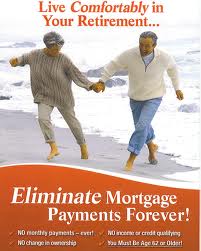
reverse mortgage.jpgMany of us have seen the slick advertisements on television for reverse mortgages. An actor who is popular with our seniors will advocate the advertiser’s reverse mortgage program as a way to tap home equity and enjoy the “good life”, the long awaited vacation or purchase of a new car or boat. However, the reality of reverse mortgages can be quite contrary to these advertisements.

A reverse mortgage is a home equity mortgage program only available to homeowners over the age of 62. These mortgages are insured by the Federal Housing Administration, a division of the Department of Housing and Urban Development. A portion of the home equity is made available for the loan, which proceeds are distributed in several ways. The homeowner can receive the proceeds in (1) monthly installments for so long as he lives in the house, (2) monthly installments for a set period of years or (3) as a line of credit that can be used as needed. Unlike a conventional mortgage, a reverse mortgage does not need to be paid until the borrower dies or no longer occupies the home as his primary residence. Not needing to make a monthly payment while having funds available for home improvements, medical expenses or other retirement needs is obviously highly attractive to seniors.

However, this author wishes to demonstrate particular concerns with respect to reverse mortgages that have actually been experienced by some of her clients. A reverse mortgage borrower must be at least 62 years of age. Let us consider a married couple that jointly owns their home, the wife is 57 and the husband is 63, meaning that only the husband can become the borrower. If the husband dies first, the surviving widow will be unlikely to repay the loan which is now due in full (without selling the house in which she may wish to continue living). The primary residence requirement may also cause difficulties. If the borrower needs to live in a residential care facility indefinitely due to medical issues, the loan will be due in full and the borrower will be unlikely to have the funds to repay. Of course, once the borrower dies, triggering the due in full provision, the lender may not patiently await receipt of the house sale proceeds needed to repay the loan and may commence a foreclosure or other legal proceeding. After the financial crisis of 2008, homes have not sold as readily as in the past, making it more difficult for survivors to sell homes to satisfy the reverse mortgage lender’s schedule. Further, with home values having dropped in recent years, there may be insufficient proceeds from the house sale to pay the loan, making the balance due from the estate.

Contact Information