 New York Real Estate Lawyers Blog


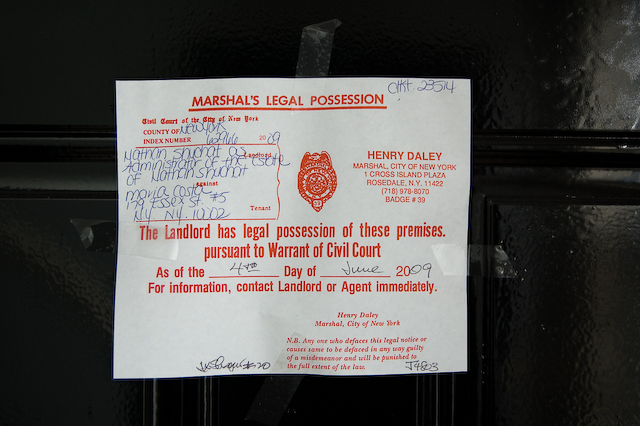 Many of our clients are landlords who own only one property, such as a single or multi-family house or an apartment. Although they may be renting to a tenant, it is not their primary business or livelihood. As such, our firm is often asked to assist in removing a tenant due to a default under the lease, or due to the expiration of the lease in question. As discussed in a prior blog post, a Court proceeding is necessary in order to gain legal authority to evict a tenant.
The legal document allowing an eviction to occur is known as a warrant or warrant of eviction. It is similar to a judgment, except that instead of stating that a certain sum of money is owed, it states that the landlord has the legal right to evict a tenant. A warrant can be obtained in several ways during a Court proceeding. If the parties agree to settle a landlord-tenant action, the tenant may agree to vacate by a certain date. A condition of such agreement (known as a Stipulation or Stipulation of Settlement) would be that if the tenant does not vacate voluntarily, the landlord is entitled to a warrant of eviction. Often, the agreement will allow the warrant to be issued immediately, but the parties will agree to stay, or delay, enforcement of the warrant until after the date on which the tenant agreed to vacate the premises.
The Stipulation allows the landlord to have a warrant of eviction, but gives the tenant a reasonable amount of time (usually a month or two) in which to vacate. A crucial part of such an agreement is also that the tenant must pay use and occupancy during the period of time between settlement and moving out. Use and occupancy is a legal term which applies to rent paid after the tenant has agreed to surrender possession. The agreement will usually state that if the tenant fails to pay such use and occupancy, the warrant may be executed immediately upon notice of default sent to the tenant, rather than on the later date previously agreed to by the parties.
 A recent
  A
A 
 Many people who pass away also leave behind the place in which they resided. The housing could be a rental apartment, a cooperative or condominium unit, or a house. The deceased may not necessarily have resided in the property immediately before death if they went to assisted living or a nursing home. This blog post will address the legal and practical matters arising from housing of the deceased.
 One of the most frequently asked questions when our firm meets with a new client relates to the awarding of attorney’s fees. Many of our landlord-tenant clients ask us whether they can recover their attorney’s fees in Court from the other party in the litigation. The answer to this question is not a simple one, and this blog post will answer under what circumstances a party may recover their attorney’s fees from the other party, whether in a landlord-tenant litigation, or other type of case.
  First, we would like to wish all followers of our blog a happy and healthy 2015. We look forward to continued successful legal outcomes for all of our clients in the New Year.
  Quite often,
 Recently in the news is the rather