 New York Real Estate Lawyers Blog


 From time to time, our attorneys become aware of updates relating to matters that we have discussed in our blog posts. This week, we have three such cases in which there have been new developments.
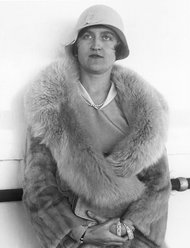
The Huguette Clark estate litigation has been the subject of a previous blog post . Our readers may be aware that the case was in the process of jury selection for a trial to be held. As is common, pre-trial procedures (and perhaps the Judge’s attitude that was displayed throughout the process) led the parties to believe that it may be more fruitful to settle the matter. Some of the details of the settlement were reported this week in the New York Times . The settlement distributed the estate as a “hybrid” of the two disputed wills. According to the settlement, distant relatives will receive a large portion of the estate (consistent with the first will) while various arts charities and a foundation will receive another large portion (consistent with the second will). The bequest to the caretaking nurse was nullified and she was ordered to return gifts received during Ms. Clark’s lifetime to the Estate. The attorney and accountant who were to benefit from the second will also had their bequests nullified. The arts charities will undoubtedly share the artwork with the general public, so that the settlement benefits the public interest. The lesson to be learned from the Clark Estate case is that those who inappropriately influence the elderly will not ultimately benefit from their acts.
Prior blog posts have discussed a federal lawsuit against Westchester County regarding grants from the U.S. Department of Housing and Urban Development (HUD). The lawsuit claimed that Westchester’s local zoning laws acted in a discriminatory manner towards those seeking to provide low-income housing.
 The fiftieth anniversary of the March on Washington was recently acknowledged, celebrating the great civil rights battle for equality for our African-American citizens. More recently, same-sex couples have also been engaged in their own battle for equal treatment in issues such as the right to marry, taxation, health and pension benefits, and similar property and economic matters.
  Our readers may be aware of an
  Our readers who follow politics know that members of Congress have battled in recent years with respect to revisions to the tax law. Specifically, estate, gift, and income taxes have been subject to adjustments. The purpose of this blog post is not to describe the
  This blog post contains a description of some of the standard substantive objections that a person may have to the admission of a Will to probate.
  Inquiries are often made of
  For various reasons, not everyone dies has a Will that disposes of their property and identifies the person authorized to manage such distribution. In such a case, the surviving heirs should
  A recent article in the
  Prevailing law in New York State favors the making of a Last Will and Testament. The person making the Will (called the testator) may leave his property to any person that he chooses. However, those who would inherit if the testator did not make a Will, known as intestacy, have the
  When an estate in New York is