Articles Posted in Real Estate Transactions and Finance

laundry-300x163We are compelled to inform our readers when there is a substantial change to regulations affecting real estate transactions.  As of March 1, 2026, sweeping changes  to financial reporting are in effect.  By way of background, “FinCEN”, otherwise known as the Financial Crimes Enforcement Network, has pertained to financial reporting of particular transactions, defined by amount and location.  Now, FinCEN, has been more broadly applied in all fifty states, regardless of the size of transaction (even zero consideration) and is a Federal compliance requirement to satisfy.

FinCEN has always been intended to quash potential money laundering in real estate transactions.  It is meant to deter those who would funnel potentially illegally obtained funds by buying and selling real estate using an entity (such as a corporation or limited liability company) without identifying the individual parties behind the entity.  All cash transactions involving entities or trusts have been identified as “high risk” for money laundering due to the potential for anonymity of the parties.  All real estate transactions as of this month are subject to evaluation as to whether reporting is required.  Further, an updated New York State transfer tax return is to be used.  The new FinCEN regulations are to be applied to residential real estate transactions with an entity buyer that is purchasing without an institutional lender.  Private lending and hard money transactions are subject to reporting because such lenders typically do not evaluate the individuals behind a purchasing entity as carefully as would an institutional lender.

Exemptions include transfers to trusts where the transferor and transferee are essentially one and the same party.  For instance, a person wishes to transfer his house to a trust in which he is the trustee.  In addition, transfers pursuant to administering an estate  or life events such as divorce are also exempt from reporting.

cancelSeveral news outlets have reported that homebuyers are canceling real estate contracts at an elevated rate.  We have previously posted about real estate transactions that do not proceed to closing.  Certainly, in this bitterly cold winter that New Yorkers are enduring, some parties are getting cold feet.

Our attorneys have observed a higher rate of cancellations by contractor purchasers.  Such entities do not intend to reside in the house and are objective and impersonal about the property.  They look at the property from a mere financial perspective.  Contractors want to purchase the property at a low cost, renovate it and then sell it to a person who will appreciate the improvements and eventually live in the house.  Perhaps these contractor buyers are looking at the numbers more carefully once they have signed a contract.  They visit the property multiple times and price the materials and tradesman costs necessary to complete the renovation.  Tariffs imposed by the current Presidential administration have made some of the building materials substantially more costly and may make a contractor’s renovation plans financially impractical.

In general, purchasers in New York cannot readily cancel a contract in the same fashion as may be possible in other states.  For instance, inspections typically take place before a contract is signed in New York.  In other states, inspections occur after the contract is signed and allow for a buyer to cancel if conditions are unacceptable.  As we have previously indicated, some of the reasons buyers cancel contracts in New York involve title issues that cannot be cleared, declination for a mortgage, or rejection by a cooperative board.  A purchaser’s refusal to waive the mortgage contingency , contrary to a previous trend, may also cause the rate of contract cancellations to elevate should a purchaser be declined for a mortgage.

gymNews outlets have reported that former gymnast Livvy Dunne’s application to purchase a NYC apartment once owned by Yankees legend Babe Ruth was rejected by the cooperative board.  Although the news was disappointing to the young social media influencer, such a decision was mostly likely a prudent one and not entirely unexpected.  This post will provide a legal analysis of cooperative board declinations.

We have previously written about the cooperative board approval process.  So long as the purchaser was not rejected due to illegal discriminatory reasons, a rejection is considered to be legally tenable.  Further, the reasons for the declination need not be disclosed.    Applicants are legally protected from discrimination if the reason that they are rejected is due to characteristics such as their race, religion, sexual orientation and the like.

Dunne’s proposed purchase was purportedly an all cash purchase, with no bank loan.  Her board application would have included proof of funds and other financial details.  Ironically enough, some boards prefer to approve a purchaser who is using a bank loan for the purchase, since the lender has professionally evaluated the creditworthiness of the proposed purchaser.  Dunne’s livelihood as a social media influencer may have been seen as without substance and fleeting by the board.  Should she “go out of style”, her income may become depleted and her ability to maintain financial obligations to the building may not be met in the future.

Flood-Insurance-300x225Our firm has often been consulted by clients who inherited a house from their parents, and wish to sell the property, as they may have moved out-of-state, and the property became vacant after the passing of the last parent.

Usually, this is a straightforward transaction, which often requires legal assistance in acquiring legal authority to sell the property as part of an estate.  This involves experienced counsel filing for letters testamentary (if there is a will) or letters of administration (if there is no will).  Once the Surrogate’s Court issues the proper legal document, then the sale can proceed.

However, there is often another issue, which may become known to the surviving children only after their parents’ death.  It is possible that the parents borrowed against the property, even after the original mortgage that they took out to purchase the premises was paid off.  Often a reverse mortgage is taken out by the elderly parents, in order to raise funds to continue to live in the house.  Generally, such mortgages are only available to homeowners over the age of 62.  Once the loan funds are disbursed, there are no monthly payments.  The full amount of the loan would then be due after the death of the last borrower.

divide1-300x199
Clients consulting our firm with respect to will drafting often ask how to leave a house or cooperative apartment to potential heirs when there may be more than one surviving child.  Perhaps a person owns a house and wants to leave it to all three of her children in her Will.  Concerns arise when one of the children has been living in the house all of his life or only one of the children frequently enjoys the use of the house as a vacation home.  In either case, the remaining children have no use for the property.  The well-intentioned parent may be inadvertently causing a family dispute after her death.  If the child who wants the property does not have the financial ability to buy out his siblings, by mortgage financing or otherwise, the remaining siblings may have no choice except for engaging an experienced attorney  to commence a partition action.

The person making the Will also needs to determine whether she wishes for her children to inherit in equal portions.  For example, if the house is of particular interest to one child and there are other assets available to be distributed to the other children, the parent may decide to leave the other assets to the other children, so that each child receives substantially similar disbursements.

We  have reviewed documents prepared by others providing that a person can continue to reside in the house until a particular triggering event such as vacating the house or death, after such event those who will inherit the property can have full access and sell it if they wish.  Such a document may provide that the occupant pay the property expenses while occupying.  This arrangement is not one that we recommend because it delays the delivery of the asset to the intended owner(s) and the occupant may not meet property upkeep demands, which provisions are difficult to enforce.

commission
We previously posted about significant changes to the rules concerning real estate agents’ commissions.  These changes became effective in recent days.  Previously, sellers paid a commission to the buyer’s agent in the amount indicated in the listing in the multiple listing service (“MLS”), the primary source of real estate listings.  The recent changes state that the seller is no longer permitted to offer a commission on MLS and is not required to pay the buyer’s agent at the sale.  This post will examine the effect that this drastic change will have upon buyers.

With the exception of “open houses,” where any buyer can arrive and tour the property, buyers who make appointments to view properties are required to sign a compensation agreement with the buyer’s agent who shows the property to them.  In particular, inexperienced first time homebuyers are at a disadvantage.  The agreement may contain terms that may be unacceptable to a buyer, such as exclusivity (agent is paid even if she did not show the property eventually being purchased to a buyer), length of time (buyers should not be tied to an agent for long time periods), conditions to be met before the commission is to be paid and price (lower percentage, flat fee or hourly fee).  In a tough real estate market with elevated interest rates, it may be counterproductive for a buyer to be responsible for the additional costs of his real estate agent as well.

It should be noted that sellers still have the option to pay the buyer’s agent’s commission, which counteracts a buyer’s agent’s inclination to steer a buyer away from a property for which she will not be compensated.  This increases the visibility of a property to buyers.

IMG_0048-225x300
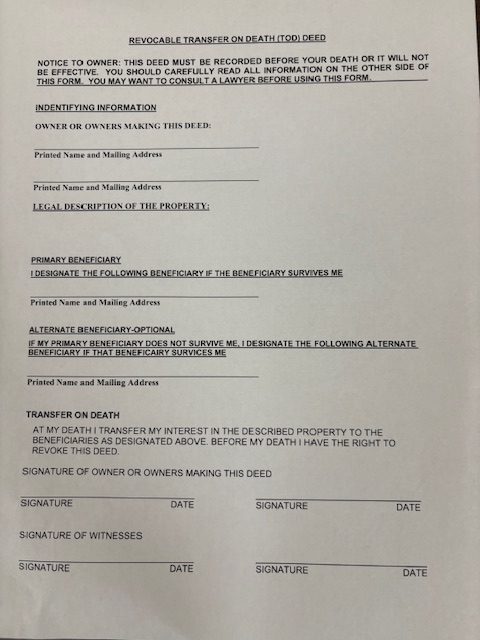
We would like to inform our readers that Transfer on Death Deeds (“TOD”) will become an option for property transfers in New York as of July 19, 2024.  Real property such as a house, condominium unit or vacant land is currently transferred by deed.  There are currently various types of deeds available for property transfers in New York State.  A Referee’s Deed applies to the transfer of property by the Court appointed Referee after a foreclosure sale.  An Administrator’s or Executor’s Deed is used by the fiduciary appointed by the Surrogate’s Court in an estate matter  to transfer property to the proper person designated by the Will or who is entitled to the property according to intestacy.  A seller in a standard real estate transaction will deliver a deed based on the level of quality of title promised to the buyer.  Such deeds may be either a quitclaim or warranty deed, or a bargain and sale deed with or without covenants.

Our readers may be familiar with transfer on death designations on bank accounts whereby the account will automatically go to the designee upon the account owner’s death.  Changes to the beneficiary can also be made during the account owner’s lifetime.  TOD deeds will operate in much the same fashion.  Such deeds will need to be signed before two witnesses and notarized before they are recorded before the owner’s death in the clerk’s office in the county in which the property is located.  Similar to the standards in making a Will, the property owner needs to have capacity, not be under fraud or duress, or unduly influenced.  The property owner retains control over the property and can sell or encumber the property with a mortgage.  The designee of the property takes it subject to any liens or mortgages to which the property is subject at the property owner’s death.  The transfer lapses if the beneficiary does not survive the owner, so it is necessary to provide for such a potential event by designating an alternate beneficiary in the TOD deed or by having a qualified attorney provide for such an occurrence in other estate planning documents.  Further, if two joint owners transfer property by TOD deed, the transfer to the beneficiary is not effective until both joint owners pass away.

The property owner can revoke a TOD deed by a properly notarized and recorded document and make a new beneficiary designation on another TOD deed, providing more control than a deed reserving a life estate.  It is important to note that a TOD deed cannot be revoked by a provision in a Will.  Transfer on death allows for the avoidance of a probate or administration proceeding as to that asset, which could prevent the delay and expense of an estate proceeding and avoid a contested estate to the extent that particular assets already have ironclad beneficiaries.  With all transfer on death designations, the property needs to be owned at death for the transfer to the beneficiary to be effective.

pcds-300x169
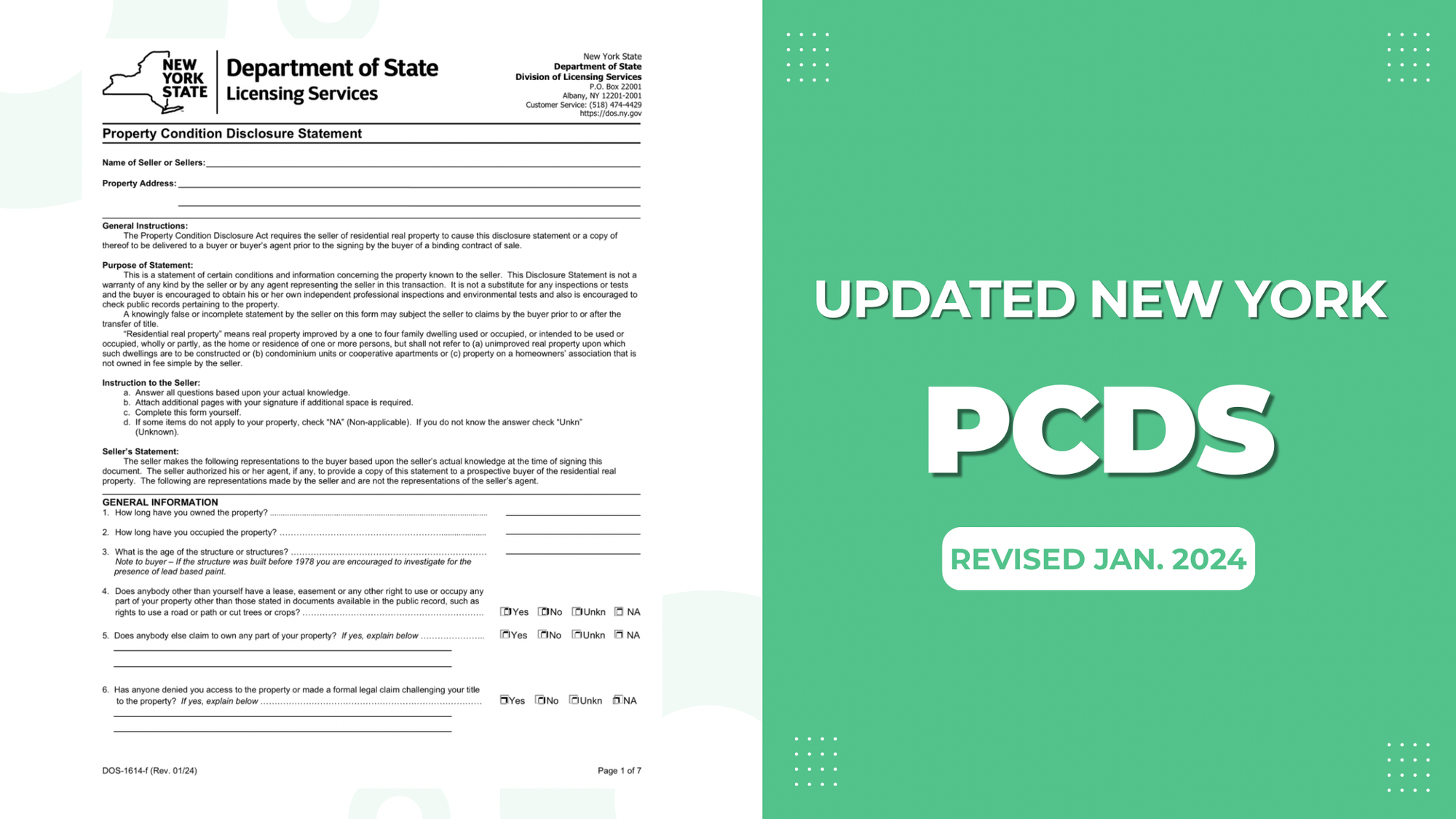
We have previously posted concerning a significant amendment to the property condition disclosure law in New York.  Previously, sellers of residential real estate were required to complete a detailed questionnaire concerning property conditions or issue a $500 credit at the closing for failure to deliver the document.  Many sellers, especially those in downstate downstate NY, as serviced by our firm, preferred to issue the $500 credit instead of completing the form.

The new law, which becomes effective on March 20, eliminates the seller’s option to issue the $500 credit.  Instead, it requires the completion and delivery of the form to the buyer before the contract is signed.  Further, it contains more extensive information concerning flood risks and history and whether the property has been insured against flood risk.  This author suggests that the amendment was motivated by devastating floods and water damage that have affected some home buyers in recent years, with the main goal being disclosure of flooding.  The legislature went further than adding flooding disclosures and moved towards requiring full disclosure by the seller.

It remains to be seen how real estate professionals will handle the amended law.  Although sellers are expected to complete the form, real estate agents may end up providing assistance.  It may be preferable that sellers have the completed form ready at the same time that the accepted offer is provided to the seller’s attorney, who will prepare and deliver the proposed contract to the buyer’s attorney, so as not to delay the process of obtaining signed contracts as soon as possible.  Otherwise, sellers may lean on their attorneys for advice in completing the form.

100-commission-real-estate-broker-300x193
We have been following several national Court rulings concerning compensation paid to buyer’s real estate agents.  A significant Federal Court ruling involved the National Association of Realtors, owner of the powerful “Realtor” trademark.  The case found that a seller should not be required to pay the buyer’s agent’s commission as a condition to having the property listed on Multiple Listing Service (“MLS”).  Similar cases in other jurisdictions have followed.  Of course, a seller could avoid this situation altogether by not even having a seller’s agent.

It had been customary practice for the seller to list her property with a real estate agent affiliated with a real estate brokerage, the “seller’s agent.”  The seller’s agent would enter the listing on MLS, making the property more readily known to buyers and their agents, the “buyer’s agent.”  Without MLS, many properties may not have been located by potential buyers.  The seller would pay a commission in the range of 5%-6% of the sales price at the closing.  When a buyer’s agent was also part of the transaction, the commission would be divided between the seller’s and buyer’s agents.

Sellers in the lawsuits challenged the requirement to also compensate the buyer’s agent, when the seller engaged its own agent, and resented the requirement to pay the buyer’s agent as a condition to having their property listed on MLS.  They suggested that commissions were inflated to allow for the buyer’s agent to also be compensated.

bew-300x140Caveat emptor is a Latin phrase loosely translated to mean “let the buyer beware.”  Real estate in New York State has customarily been transferred under this concept, meaning that the seller is not obligated to disclose property conditions and the onus is on the buyer to discover conditions that may be objectionable.  In 2001, this concept eroded somewhat with the enactment of Article 14 of the Real Property Law, known as the property condition disclosure statement law (“PCDSL”).  Sellers of residential property were required to complete a lengthy questionnaire concerning property conditions.  If the seller preferred not to complete the form, the seller was required to issue a $500 credit to the buyer at the closing, as was customary in downstate counties serviced by our firm.

Recently, Governor Kathy Hochul signed an amendment to the PCDSL that added disclosures concerning flood risks and history.  Most significantly, the amendment, which becomes effective on March 20, 2024, removes the seller’s option to issue a $500 credit to the buyer and requires the completion of the questionnaire before the contract is signed.  The law explicitly states that it is not a warranty by the seller and does not substitute for inspections that the buyer may conduct.  Typically, a real estate agent or experienced real estate attorney will recommend that the buyer hire a professional inspector to evaluate property conditions.  Inspectors will often discover concerns such as asbestos in the furnace room.  A qualified attorney may integrate repair issues in contract negotiations.  Armed with additional information from the completed disclosure form, a buyer may threaten to walk away from a transaction without additional contractual concessions.

The new law provides that knowingly false or incomplete statements made by the seller can subject the seller to claims after the closing.  This is a departure from standard New York law whereby the buyer’s acceptance of the deed at the closing is deemed to be full acceptance of any property conditions, whether known or unknown to the buyer.

Contact Information